
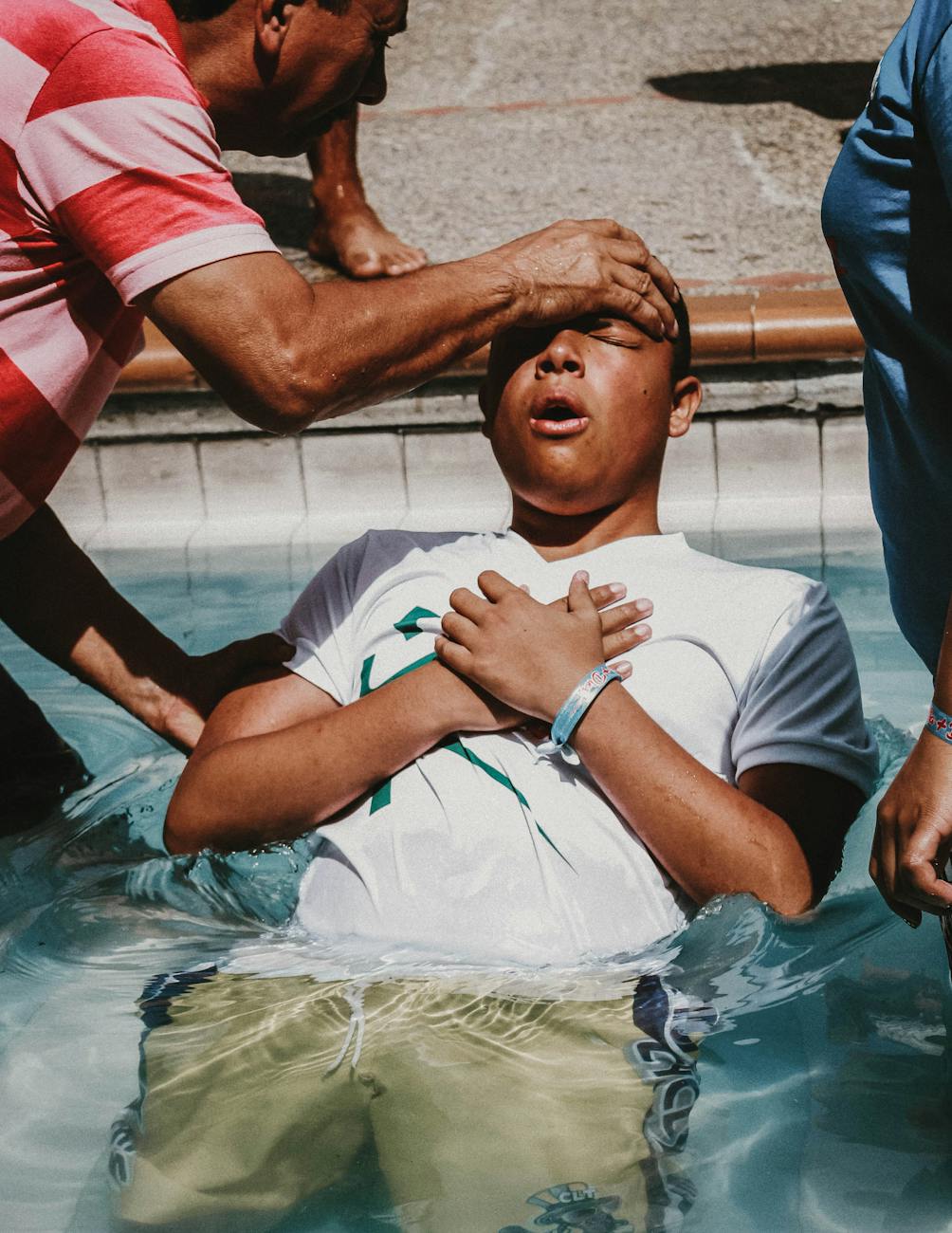
Baptism is the practice of immersing new Christians in a pool of water as a powerful and symbolic act, an outward sign of our inward faith. Some Christian traditions practise baptism by sprinkling water on babies as their parents commit to bringing them up in the Christian faith (sometimes called ‘christening’ or ‘infant baptism’). The child may then later ‘confirm’ this commitment in a ‘confirmation’ ceremony when they are of an age to decide for themselves that this is what they want.
However, in this resource we will look at what is often called believers’ baptism. This is when a person who has newly put their faith in Jesus and made a commitment to follow him is publicly immersed into a pool of water as a outward sign of that commitment. It is called believers’ baptism because it happens after a person has believed in Jesus (rather than as an infant who cannot make such a decision).
When Jesus sent his first followers to call other people to be his disciples, or followers, he told them to start by baptising them:
“…go and make disciples of all the nations, baptising them in the name of the Father and the Son and the Holy Spirit.” (Matt 28:19).
When some people first heard the Christian message about Jesus and asked the Christian leaders what they had to do in response, they were told ‘Repent and be baptised.’ (Acts 2:38). This shows the priority and importance of baptism. In some powerful way, it is sealing and securing your inward faith-decision to follow Jesus. One reason for this is that it is an open and public expression of your new faith.
An Act of Confession
The Bible teaches us that the confession of our faith is very important. Confession is the public declaration of your faith. In the Bible, we are taught that ‘it is by believing in your heart that you are made right with God, and it is by openly declaring your faith that you are saved (Rom 10:10). Notice the importance placed on confession by linking it with faith. In some way, the outward confession is a part of us entering the experience of salvation. It is not enough to keep faith inside as a private belief. We must go public. One of the best things you can do when you first become a Christian is to tell someone what you have done. Obviously, the usual way of confessing our faith is by using our mouths – telling people. But being fully immersed in a pool of water is a very visual, dramatic and public way of demonstrating your new faith.
A Step of Obedience
As well as being a dramatic way of going public, baptism can be, for some, the very first test of obedience. When Jesus first told his first followers to baptise new followers, or disciples, he continued with the words: ‘Teach these new disciples to obey all the commands I have given you.‘ (Matthew 28:20). As a disciple of Jesus Christ you are called to a life of obedience. This is what you mean on a personal level when you say ‘Jesus is Lord.’ By requiring such a clear and public act like baptism right at the outset of the Christian journey, our real willingness to obey him is tested. Of course, it is possible just to go through it as an empty ritual without a real heart of faith and obedience. This will achieve nothing other than getting wet. But if you are sincere, baptism is a very powerful act of obedience that sets the direction of your new life.
A New Identity
All of us were born with a kind of spiritual and moral disease. The Bible calls it sin. This does not mean that we are all thoroughly evil or incapable of any good. It just means that all of us can’t help but do what we know is wrong at times. We certainly all fall short of God’s ideal. The true Christian way of dealing with this is not to try to beat it out of us, or to make efforts at self-improvement, or even just to try our best and say sorry when we fail.
The Bible tells us that God deals with it by getting rid of that old identity, or way of life, and bringing us into a new life. Baptism is central to this because, in baptism, we are ‘identifying’ with Jesus in his death and resurrection. When we go down into the waters of baptism, we are identifying with his death and burial. We die to that old life and to the power of sin over our lives:
…have you forgotten that when we were joined with Christ Jesus in baptism, we joined him in his death? For we died and were buried with Christ by baptism. (Romans 6:3-4)
Then, as we are brought up out of the waters of baptism, we are identifying with his resurrection and are being raised to a new life and identity:
And just as Christ was raised from the dead by the glorious power of the Father, now we also may live new lives. (Romans 6:4)
This new identity is established in our baptism. It shows us that living the Christian life – our new life – is not about trying our best to be a better person. It is about trusting what God says about us and learning to live in the reality of this new identity:
…you also should consider yourselves to be dead to the power of sin and alive to God through Christ Jesus. (Romans 6:11)
The chapter in the Bible that helps us to understand this best is Romans 6. It is not an easy passage to understand and there will soon be another post to help you unpack it – Learning to Live in Our New Identity. It shows us that baptism helps us to understand the importance of the vital phrase we come across again and again in the New Testament – ‘in Christ.’ Learning this truth is central to following the way of Jesus.
From the Bible:
…anyone who belongs to Christ [is in Christ] has become a new person. The old life is gone; a new life has begun! (2 Corinthians 5:17)
For Reflection and Discussion
- Why do you think it is important to go public about your new faith?
- How can baptism be thought of a test of obedience?
- How do you think that understanding your new identity ‘in Christ’ might help you to live the Christian life? And how will baptism help you?
Steps To Take:
- If you haven’t already been baptised, speak to the person who is mentoring you or to one of the church leaders about doing it.
- Read, meditate on and pray through the teaching of Romans 6. Don’t worry if you don’t understand it all, but ask the Holy Spirit to help you get it in your heart and not just in your mind.
- Next time you are tempted to do something that you know is wrong, remind yourself of your baptism and tell yourself that you are now a new person, and that you don’t live that way anymore. Make a habit of doing this.
Remember this:
Baptism is a moment of surrender and submission, as we let go of our old selves and surrender to God’s will for our lives. (Christine Cain)
Recommended Resources
Victor Jack, Believe and Be Baptised – a very helpful booklet that explains baptism and its importance
A helpful article from Christianity.com



Leave a comment