
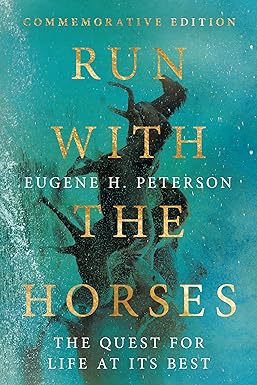
How do we live life at its best? What is the good life? Is it getting all we ever dreamed of? Do we find it by adopting the latest self-help theories? Not according to Eugene Peterson. The person he chooses to use as an inspiring example of the good life is something of a surprise – the prophet, Jeremiah. This lonely prophet preached mainly about God’s judgement on his people and was often rejected and persecuted by them for his pains. Many things seemed to go disastrously wrong for him and, at times, he got angry with God and appeared close to despair. There is even a word in the English language that is taken from his name and means a long and mournful complaint – a jeremiad! He wrote Lamentations, for goodness’ sake! So why would Peterson choose him as our inspiration in our quest for life at its best?
The book explains why. It starts, fittingly in light of its subject, with a lament about how much of life in our world is trivial and shallow. How much it is filled with nonsense and wickedness. How it celebrates celebrities rather than saints. It was originally written in 1983 but his analysis seems just as accurate still. He doesn’t stop there though. He shows where hope lies. In a wide range of rich reflections on the biographical parts of the book of Jeremiah, he gives us insights into why this remarkable man is a model for a life of excellence, an example of ‘mature, authentic humanity’. His life is defined by his relationship with God, not by comparing himself to others. By being part of something greater than himself. By living by faith in the unseen, rather than by what is popular and apparently impressive. By personal integrity, rather than ‘shuffling along with the crowd.’ By perseverance and prayer. By choosing to live at his best, no matter his circumstances. By facing life as it was and not how he would have liked it to be.
In teaching us what the good or blessed life looks like, Jeremiah’s example and message anticipates ‘the great reversal’ that we see in the Sermon on the Mount. It is not the rich, the successful, the popular and applauded who are experiencing the good life. In God’s different kingdom, the blessed are the poor in Spirit, those who mourn, those who hunger for righteousness, the pure, the humble, the persecuted. Those like Jeremiah. Those like Jesus.
Be warned. Peterson is not an easy read. He challenges the idea that a good book is one you can’t put down. That might be true for some novels. But, in fact, a really good book is one you have to put down regularly to think about. Peterson’s books are like that. And this is one of my favourites. He does not skim the surface with predictable, popular, tweetable phrases. He requires us to dig deeper with him to understand a life of faith and faithfulness when we live with bruised souls in a broken world. The digging is worth the effort.
I encourage you to read the book itself – slowly. But if you want a taster, or you know you are unlikely to read the book but would like to glean some of its rich insights, I have written a summary of the book which you can find here. The summary can also help as an helpful refresher if you have already read and enjoyed the book.



Leave a comment