
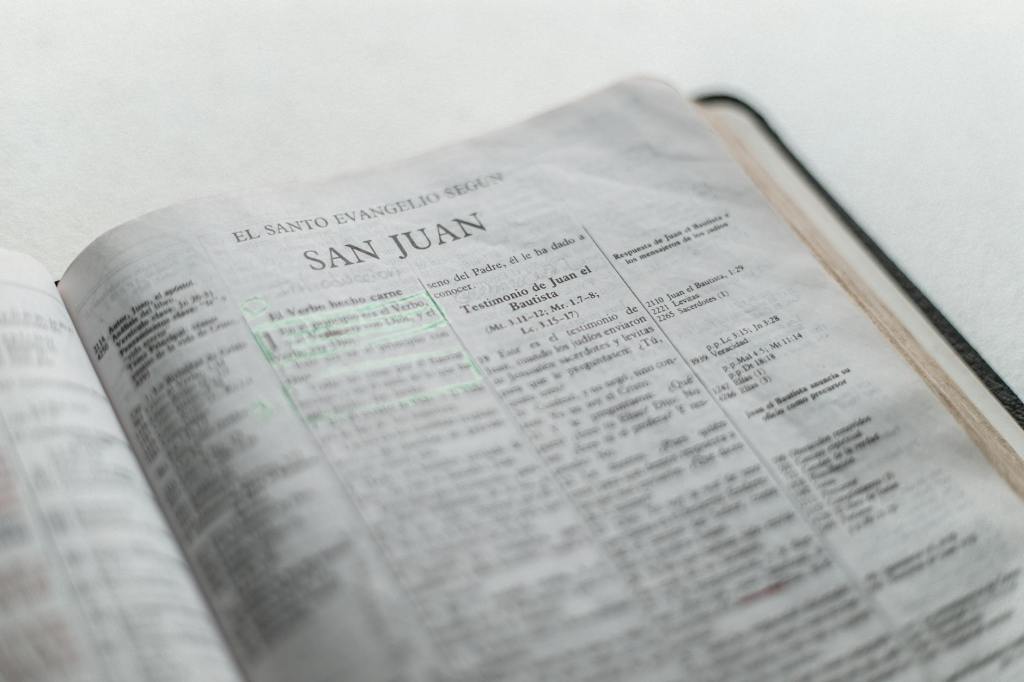
Background
John’s Gospel stands apart from the other three Gospels, known as the Synoptics (Matthew, Mark and Luke), in both structure and style. Most scholars agree that John’s Gospel was likely the last to be written. Rather than repeating familiar material, John offers a theologically rich and reflective account that supplements the earlier Gospels.
He doesn’t appear to write specifically for a Jewish or Gentile audience, but rather to anyone willing to consider who Jesus truly is. His clear aim is to establish that Jesus is the Son of God — fully divine, fully human — and to call readers into a life-giving relationship with him through faith (see John 20:30–31).
Throughout the Gospel, John presents Jesus as the one sent by the Father, full of grace and truth, and speaks often of the Holy Spirit, whom Jesus promises to send to empower his followers.
Key Themes
Father, Son and Spirit
The Trinity is never named explicitly, but its reality is deeply woven into John’s Gospel. The actual word ‘Trinity’ doesn’t appear anywhere in the Bible but the relationship between the Father, Son and Holy Spirit features very strongly in the gospel of John. Jesus is shown constantly in relationship with the Father — sent by him, glorifying him, and revealing him. He also promises the Holy Spirit who will guide, comfort and empower his followers. John invites readers not just to understand these relationships but to step into them.
Seven Miracles and Signs
John structures his Gospel around seven carefully chosen miracles, which he calls “signs.” Each one reveals something essential about Jesus’s identity and mission: He states that he’s recorded these particular miracles so that his readers may believe who Jesus is and, by believing, have life in his name (John 20:30-31). John’s purpose is not just to establish theoretical doctrine but to be used by the Holy Spirit to inspire a living and continuing faith.
The seven miracles each reveal different aspects of the rule and reign of Jesus:
| Miracle | Reference | Area of Power |
| Changing water into wine | John 2:1-11 | Quality: Jesus pours out amazing blessings in our lives. |
| Healing the nobleman’s son | John 4:46-54 | Space: Jesus is not limited by being in a certain place but his power extends throughout the earth |
| Healing the lame man at Bethesda | John 5:1-9 | Time: Jesus is not limited by how long the problem has existed or whether or not it’s a good time in human terms |
| Feeding the five thousand | John 6:1-14 | Quantity: Jesus is not limited by a lack of resources – He can multiply anything |
| Walking on water | John 6:16-21 | Natural law: Jesus is not limited by the laws of science and nature |
| Healing the man born blind | John 9:1-12 | Circumstance: Jesus is not limited by the distressing circumstances in life |
| Raising Lazarus from the dead | John 11:1-46 | Death: Jesus is not limited by the power of death. |
‘I Am…’
Seven times Jesus makes bold claims using the divine phrase “I am” — echoing God’s self-revelation to Moses in Exodus 3:14. These statements are not just poetic metaphors; they reveal his identity as God in human flesh:
| Statement | Reference |
| I am the bread of life | John 6:48 |
| I am the light of the world | John 8:12 |
| I am the door | John 10:9 |
| I am the good shepherd | John 10:11 |
| I am the resurrection and the life | John 11:25 |
| I am the way, and the truth, and the life | John 14:6 |
| I am the true vine | John 15:1 |
Jesus repeatedly used the ‘I am’ expression to reveal his true divine nature. In John 8:58 we read:
Jesus said to them, “Truly, truly, I say to you, before Abraham was, I am.” (ESV)
Preparing His Disciples
The Gospel divides naturally into two parts. Chapters 1–12 focus on Jesus’s public ministry and his signs. Chapters 13–21 slow down to describe the final week before the crucifixion. In these later chapters, Jesus turns to prepare his disciples: teaching, praying, and pointing to the coming of the Holy Spirit. His final words and actions are deeply personal and form a rich theology of mission, intimacy with God, and the life of the Spirit.
Jesus tells his disciples that he is sending them into the world in the same way that the Father sent him into the world (John 20:21). He explains to them the importance of faith and the Holy Spirit. Through his gospel, John makes it clear that, having understood who he is, Jesus wants those who believe in him to make him known throughout the earth:
“…whoever believes in me will also do the works that I do; and greater works than these will he do, because I am going to the Father.” (John 14:12 ESV)
The Message for Today
John’s Gospel speaks directly into the heart of questions that more and more people are asking: Who is Jesus? What is truth? Where can I find life that lasts?
John doesn’t just tell us that Jesus is divine. He shows us what that means for us. Jesus is not remote or theoretical. He enters real stories, real sorrows, real celebrations. He brings hope to the outcast, sight to the blind, and life to the dead. He offers not just answers, but presence — a relationship with the living God.
This Gospel calls us to more than belief in facts. It calls us to personal trust. In a world full of competing narratives, John invites us to abide in the true vine, walk in the light, and feed on the bread of life.
Different Kingdom Lens
John’s Gospel shows us a radically different kind of king and kingdom. Jesus conquers not by force but by sacrificial love. His greatest moment of glory comes not through triumphal conquest but through being lifted up on a cross (John 12:23–24). Power, in this kingdom, looks like foot-washing and forgiveness. Leadership looks like laying down one’s life for friends.
Jesus sends his followers just as he was sent: not to dominate, but to serve, not to impress, but to embody truth and love. In John’s vision, the way of the cross is not a detour. It is the very shape of God’s kingdom.
And Jesus says: “As the Father has sent me, I am sending you” (John 20:21). That’s not just a mission. It’s a way of life.



Leave a comment