
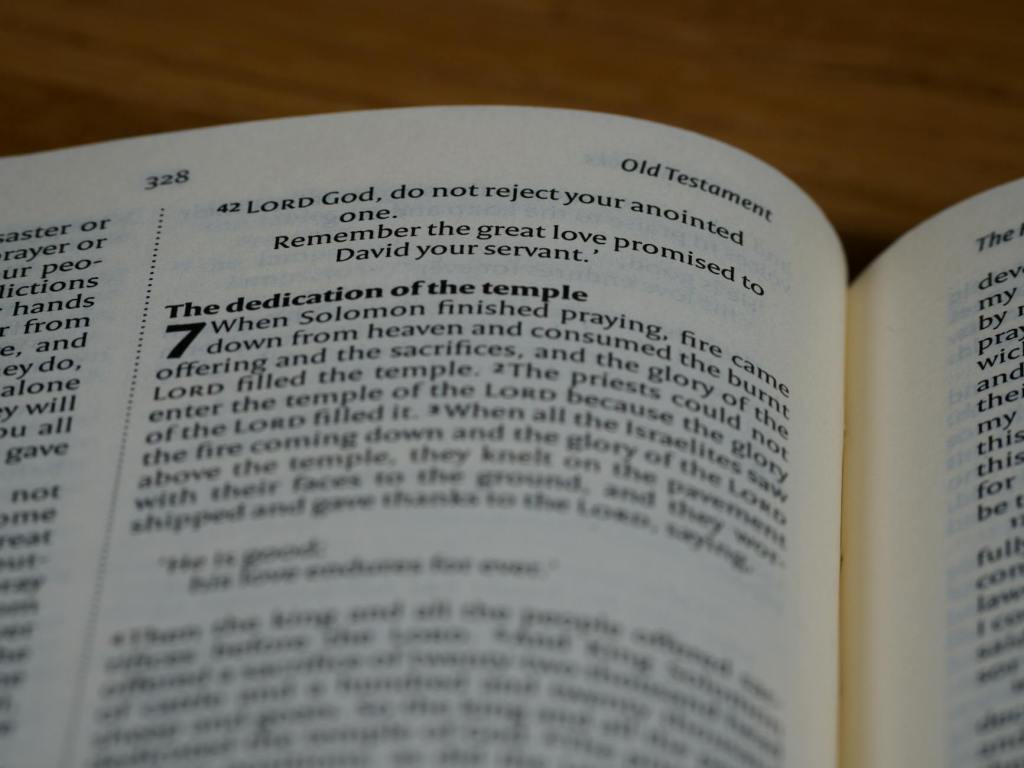
1 and 2 Chronicles were originally one book, written after the Jewish exiles returned from captivity in Babylon. The books were written approximately 430BC, with tradition attributing the writing to Ezra. They cover the historical period from the death of King Saul around 1000BC to the end of the period of captivity in 538BC. The death of King David, around 960BC, provides the division between the two books.
A God of Purpose and Restoration
Chronicles presents a history of Israel for the Jews, who had recently returned from exile in Babylon. It highlights the fact that God was faithful to his covenant. While the books of 1 and 2 Kings were written for an exiled community, Chronicles was written to a restored community. The two books look back at history, right back to Eden, and encourage faith for the future.
The question that a community returning from exile was asking was: ‘Is God still interested in us?’ ‘Without a king, what will become of the covenant people?’ Chronicles was written to show the returning exiles that God had not abandoned his plans to have a people for himself, and for his presence to be among them. Despite Israel’s unfaithfulness, God will remain faithful to His covenant.
“If my people, who are called by my name, humble themselves, and pray and seek my face and turn from their wicked ways, then I will hear from heaven and will forgive their sin and heal their land.” (2 Chronicles 7:14)
More than an alternative history to that which we read in the books of Samuel and Kings, it is written to bring a theological framework to God’s restoration people. In Chronicles, we see not only the God of justice but also the God whose ‘hesed‘ – his loving kindness – never fails. God speaks to David about the Messiah to come:
“When your days are fulfilled to walk with your fathers, I will raise up your offspring after you, one of your own sons, and I will establish his kingdom. He shall build a house for me, and I will establish his throne forever. I will be to him a father, and he shall be to me a son. I will not take my steadfast love from him, as I took it from him who was before you, but I will confirm him in my house and in my kingdom forever, and his throne shall be established forever.’” (1 Chronicles 17:11-14)
Chronicles declares that God is a God of restoration, and his people must prepare for the coming King.
The Kingdom and God’s Rule
During the reigns of David and Solomon, the splendour of the kings of Israel and the kingdom of Israel reached its peak. These two kings were types of Christ, and the kingdom of Israel points to the far more wonderful Kingdom of God.
The Temple and God’s Presence
The temple speaks of the presence of God with his people, and is a foreshadowing of the church where God dwells by his Spirit. From David’s preparation to Solomon’s dedication, right through to Nebuchadnezzar’s destruction of it, the temple is a key theme throughout both books. The first task of the community returning from exile was to rebuild the temple. The temple – representing the dwelling place of God – also foreshadowed the Messiah coming to dwell with his people in the person Jesus of Nazareth, and subsequently in the church, by the Holy Spirit.
Overview of the Books
1 Chronicles 1- 9
The book, beginning with Adam, records several genealogies of the people of Israel. These lists show both God’s concern with individuals and that the people recorded in them provide a line of the continuity of faith right back to creation.
1 Chronicles 10-21
Of Saul only his death is recorded, and the account of David shows him as a champion warrior King. David brings the Ark to Jerusalem. This event gives prominence to David rightfully restoring the presence of God in the nation of Israel.
1 Chronicles 22-26
Preparations are made for building the Temple. Linked to this is the organisation and administration of those who would minister at the temple: the priests, singers, gatekeepers and other temple officials.
1 Chronicles 27-29
These chapters record the army divisions and the officials of the tribes of Israel. David reveals that it is not he but his son Solomon who is to build the Temple he had planned. The book ends with the death of David and Solomon becoming King.
2 Chronicles 1-9
The second book of Chronicles opens with Solomon asking for wisdom, and him then going on to build the Temple. The writer brings parallels here with the building of the tabernacle in the Pentateuch, with Solomon anointed for the task as the new Bezalel. On completion of the temple, as with the tabernacle, the glory of God appears. Chapter nine ends with the death of Solomon.
2 Chronicles 10-36
After the division of the Kingdom, the book records the Kings of Judah. Most of the narrative is taken up with the five main Kings who brought reform to temple worship: Asa, Jehoshaphat, Joash, Hezekiah and Josiah. The book ends with the destruction of Jerusalem, exile to Babylon, a Sabbath rest for the land, and the decree by Cyrus, king of Persia, to rebuild the Temple in Jerusalem.



Leave a comment