
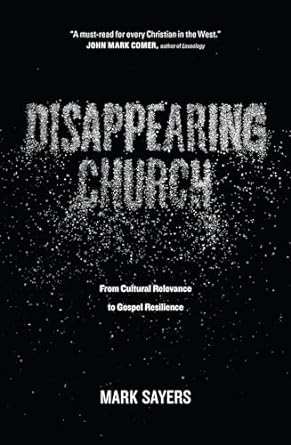
A challenge to the church to focus less on being relevant to our culture and more on being resilient disciples within our culture.
How are we to navigate our secular, constantly shifting, and supposedly post-Christian culture? It’s not at all easy, but there are some gifted Christian cultural commentators who can help us. One of the best is Mark Sayers, a pastor, podcaster and writer from Melbourne, Australia.
In the years just before the Covid pandemic, Sayers published two books that incisively addressed the cultural moment in which we found ourselves in the West. Although things are moving on from some of the trends and challenges he addressed, these books are still very relevant and insightful.
The first, Disappearing Church, came out in the crazy year of 2016. The second, Reappearing Church, was published (2019) just before the the Covid pandemic struck. The pandemic exacerbated some of the cultural trends that Sayers identifies as well as creating some new ones.
Although the books are not always an easy read (depending on what you are used to), they contain some vital insights and challenges for Christians in today’s world.
In Disappearing Church, Sayers offers an incisive critique of the me-centred culture that we live in, identifying in it a new form of an old enemy – Gnosticism. This confused cluster of constantly mutating beliefs took shape around the same time as Christianity was emerging. Its current form in our culture puts a focus on individualism, self-development, even self-creation, rejection of restraints, and escape from the mundane into the ‘beautiful culture’ of the progressive, tolerant, inclusive world. And to the disembodied, digital and superficial experiences and expressions of our hyperconnected but lonelier-than-ever world. It replaces authentic and substantial community with fluid but fickle networks. Many of Sayers’ descriptions of this Gnostic-shaped culture, and his insights about it, remain pertinent still.
But Sayers is not just criticising the world. He is challenging the church. Christians have focused too much on trying to be culturally relevant and on catering to public opinion. In seeking to reach the culture in this way, the church finds itself becoming just like the culture. It has nothing different to offer. In the process of such exercises in cultural relevance, some even abandon orthodox beliefs and ethics. In contrast, he argues, we need to learn the faithfulness and resilience that comes from the gospel, from following the narrow, countercultural path, from living in obedience to Jesus as our Lord. We are not seekers of self-development and self-fulfilment. We are slaves of Christ.
This means, suggest Sayers, that we must lean into the uneasy tension of distancing ourselves from the culture in order to then fruitfully engage with the culture. In other words, we must follow the way of creative minorities, like some of the original monastic communities. It is the way of ‘withdrawal and return.’ Withdrawing from the culture in order to return to the culture, with the intention of engaging and transforming it. It means ‘to go deep in order to go wide’. It is to become what Sayers calls ‘extremophile disciples‘ , those who can survive and thrive in the hostile landscapes of our culture.
Such resilience requires us to have deep roots and foundations – in our inner lives, and also in our communal lives within the local church. Sadly, churches have too often followed the way of many organisations in our modern world in moving from what Sayers calls ‘code’ (a sense of duty, commitment, sacrifice) to ‘pitch’ (adding to the many competing offers of personal fulfilment and beneficial experiences). This has undermined what church community is truly all about. Part of ‘gospel resilience’ is to live in the ‘muck and grace’ of a local church community that confronts us with the reality of messy but meaningful relationships, under the lordship of Jesus Christ. This is the real alternative to our individualistic culture.
I recommend you read the book if you can. If you’d like to try a taster first, or if you struggle with extended reading, you could try my LifeWords summary of this excellent book here.
You can also see my review of Reappearing Church here.





Leave a comment