
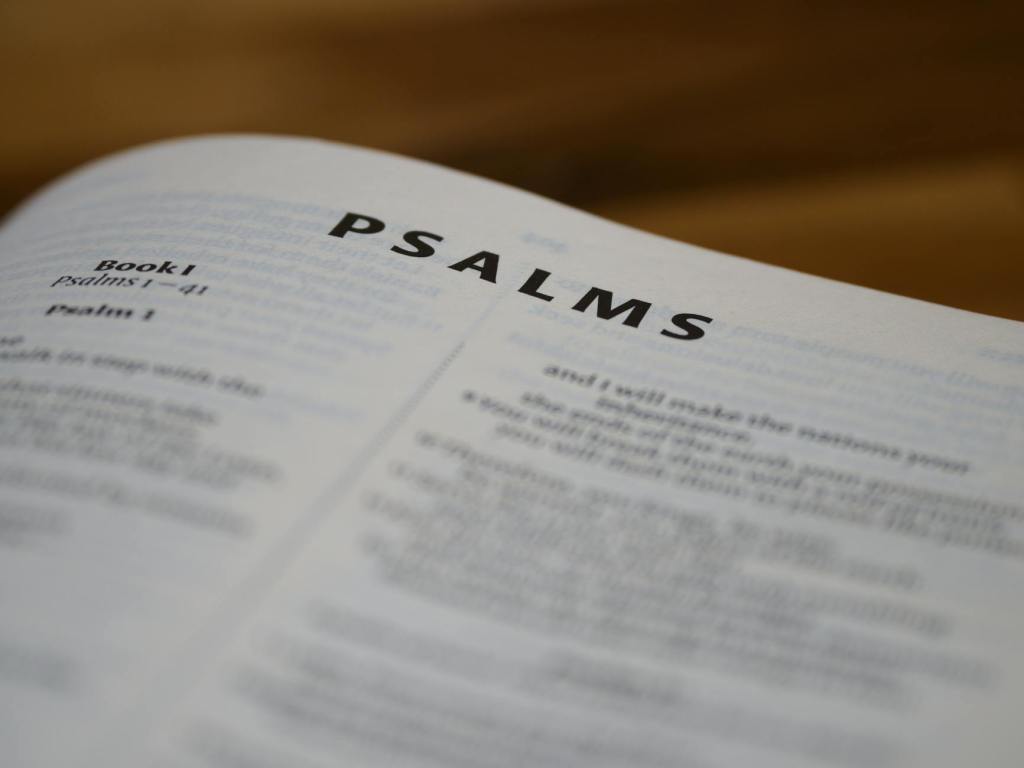
The Book of Psalms was the song-book of ancient Israel. Through the history of that nation, it was a growing collection of songs of praise, worship and prayer for national festivals and temple worship. They were written over a period of about 1000 years. The division of the Psalms into five ‘books’ may reflect older collections of the psalms, as well as intentionally mirroring the five books of the Pentateuch (Genesis-Deuteronomy).
These songs are also intended to play a vital part in the worship of the contemporary church. They are an essential part of our three-fold expression of musical worship to God – ‘psalms, hymns and spiritual songs’ (see Eph. 5:19, Col. 3:16). As they are primarily about the eternal and unchanging God, they are timeless in their application.
The psalms fulfil a number of functions: there are prayers (e.g. 38, 79), songs of praise (e.g. 33, 81), teachers of God’s Word (e.g. 37, 60), expressions of hope for God’s coming kingdom (e.g. 46, 27, 67), and anticipations of the New Covenant (e.g. 89, 110).
It is possible to group the psalms according to their content and style, and understanding some of these will help us in approaching the psalms:
Praise
This is probably the largest category of psalms. Some are a declaration of God’s attributes and others are expressions of thanksgiving, often through descriptions of God’s acts.
Lament
Some psalms seem very negative at first reading. This is because they are laments (expressions of pain and longing). However, these psalms express a proper way to deal with the challenges and difficulties of life – by addressing ourselves to God. They may be a means of asking God serious questions about the human condition, but they nevertheless retain a confidence in God’s sovereignty and goodness.
Lament and praise
These differ from simple laments in that the ‘trouble’ or ‘enemy’ is not the main focus of the psalm, but rather God. This leads to a cycle of prayer and praise, e.g. Ps 62, 73, 90.
Enthronement Psalms
These are songs that celebrate Yahweh as King. The words “The LORD reigns” are common (93:1, 97:1, 99:1). These psalms are: 29, 47, 93, 96-99. Another related and overlapping category is the “Royal Psalms” (2, 18, 20, 21, 45, 61, 63, 72, 89, 101, 110, 132, 144).
Wisdom
These are related in style to wisdom literature. They characteristically uphold the virtues of godliness, the rewards of God and the contrasting ways and ends of the righteous and the wicked. Psalms of this type include: 1, 10, 12, 15, 19, 32, 34, 36, 37, 49, 50, 52, 73, 78, 82, 91, 94, 111, 112, 119, 127, 128, and 139. There is considerable overlap with other groups of psalms.
Zion Songs
These psalms are 46, 48, 76, 84, 87. They speak in glowing terms of a idealised, spiritualised Zion (a picture of the church as the city of God, his governed community). It is clearly a Zion beyond any literal Zion that existed in history. They show Zion in its ‘ultimate intention’ state, as a picture of the restored city of God. It is interesting to note that this place is seen as the ultimate destination and reward in the Psalms, in contrast to death and the grave.
Pilgrim Songs
These songs of ascents [120-134] form one of the clearest groupings in the psalms. They are associated with the national feasts of the Israelites and were collected together – or, with some, originally composed – to be sung on the ascent to Jerusalem. They were also possibly then sung again by the priests as they climbed the 15 steps to the temple, one song sung on each step up towards the presence of God.
Creation Praise
The name says it all! Psalms 8, 104, 139
Hallel Psalms
Hallel means praise. Hallelujah means praise the Lord. These do not constitute a literary genre, but are formed from 3 smaller and distinct collections:
The Egyptian Hallel [113-118]
The Great Hallel [120-136, including the songs of ascent]
The Concluding Hallel [146-150]
They were used for praise at the annual feasts as well as in daily (or weekly) prayers in the smaller community.
One final thought. The whole Bible is not designed primarily to be read but to be spoken. When it comes to the Psalms they are songs to be sung! Simply reading the words on the page will mean we miss out on much of what God intends for us in them. So open your mouth and lift your voice and sing them to the Lord!



Leave a comment