
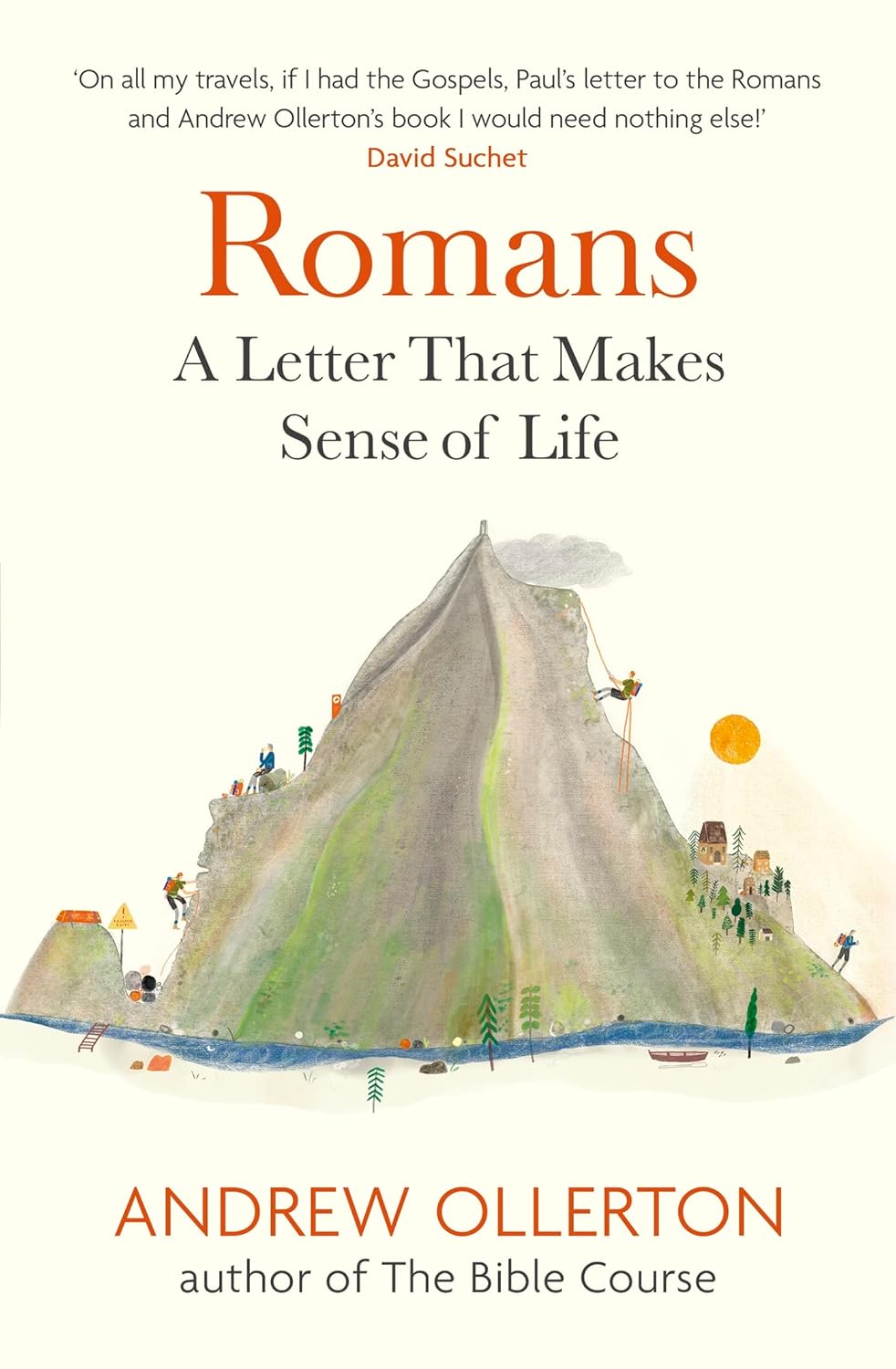
An invitation to ascend the highest summit in the mountain range of biblical literature
Mountain climbing is not my thing. I have not got a head for heights. But Andrew Ollerton’s passion for scaling peaks is unmistakable as he uses it as an engaging analogy for navigating Paul’s letter to the Romans. He envisions Romans as the highest summit in the mountain range of biblical literature, and invites readers to ascend the rich truths about our great salvation articulated in Paul’s finest letter. Although the mountaineering metaphor occasionally feels a bit contrived, Ollerton’s evident passion for mountain climbing and for Romans makes his overview both compelling and insightful. He highlights Romans as a pivotal biblical text that every Christian should explore.
Having thoroughly enjoyed his previous book — his excellent introduction to and overview of the Bible — I was predisposed to like this introduction of Romans. While it did not quite match the brilliance of his earlier work, I still found it a worthwhile and engaging read. As a fan of expositions on books of the Bible (though not so much of heavy scholarly commentaries), I appreciate works that combine responsible hermeneutics, accessible yet robust theological reflection, and thoughtful practical application. Over the years, I have enjoyed some of William Barclay’s Daily Study series, the Bible Speaks Today series, Warren Wiersbe’s Be…series, and, in more recent years Tom Wrights New Testament For Everyone series and The Story of the Bible series. These works generally avoid the density of scholarly commentaries while providing clear structure and thoughtful insights. Ollerton’s introduction to Romans does this exceptionally well, offering an accessible and panoramic view of the letter while balancing theological, devotional, and practical reflection.
One of the book’s strengths is how it sets Romans in its historical and social context. The author starts at the end by highlighting the significance of the people listed in Romans 16, drawing attention to the radically subversive nature of the early Christian community, in its time. By tracing how the letter is relevant to the deep-rooted relational dynamics between the early Jewish and Gentile Christians, he keeps the biblical theology real and rooted. He has clearly been influenced by N.T. Wright in this, and shows how justification by faith relates not only to personal salvation but to the question of who belongs to the covenant people of God, and the implications of this. Ollerton’s clear outlining style makes these and other big themes digestible, leading the reader through the text with clarity and purpose.
Some of the book’s most compelling sections included his treatment of Romans 6–8, which he handles skilfully, inspiring readers by revealing the profound truths of our salvation from both personal and cosmic perspectives. He regards Romans 8 as the peak of the mountain. Equally, he did not avoid the difficult passages. He handled Romans 1 with much needed skill and sensitivity, and was fair-minded and balanced in presenting the different ways of reading Romans 7. He regards Romans 9-11, which cover the controversial topics of election and the role of Israel, as probably the most difficult of the letter. (He compares them to the mists that can sometimes catch you unawares when you start descending from the peak of the mountain). I resonated with his vocational view of election but struggled a little with his take on God’s sovereignty and election in relation to personal salvation. While I appreciate the recognition of mystery in theological discussions, I feel that sometimes it can be used to avoid some of the theological challenges. That said, his perspective on Israel – focusing on the future hope of significant conversion among Jewish people, rather than the occupation of the land with all the problematic implications of that – was refreshing.
However, it was the later chapters (coming down from the mountaintop back into the real world of community) that I found particularly resonant. His discussions on Romans 13 and 14 are especially relevant in today’s polarised climate of echo chambers and cancel culture. We need the gospel, surely more than ever, to inform our engagement with society and with one another in Christian community. These final chapters stand out as some of the best for me, effectively showing how biblical theology is practically relevant.
Ultimately, this book succeeds as an introduction to Romans, offering a clear pathway through a dense and theologically rich letter. It avoids oversimplification while also ensuring that the reader does not feel lost or overwhelmed. If you appreciate introductions and overviews of biblical books that illuminate both the text and its application to life, this is a rewarding and thought-provoking read.
You can find a LifeWord Book Outline on this book here.
Watch Andrew Ollerton’s own introduction to his book here.
Find his book at:




Leave a comment