
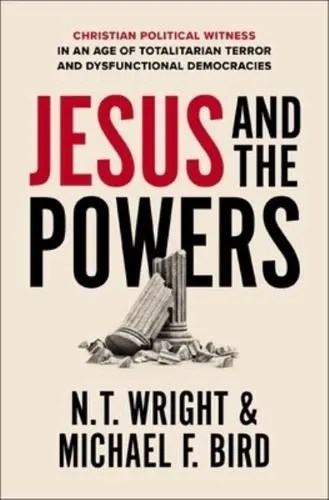
Biblical guidance on how to respond to the current political turmoil in our world
This isn’t a light read. The early chapters of Jesus and the Powers are thick with biblical theology, as they trace how God’s people have always lived under the looming shadow of empire. From Pharaoh to Caesar, from Babylon to Babylon again, whatever name it now bears in the modern world. It’s a rich and rigorous book, but at times dense enough to lose the ordinary reader in the thickets of Scripture and scholarship. Yet the question it raises is clear – the Church has always had to ask how to live for the kingdom in a world seemingly ruled by ‘the powers’.
The authors use this biblical concept to refer to the spiritual and structural forces – visible and invisible – that shape societies, institutions, and cultures. They include political regimes, ideologies, economic systems, and social hierarchies. While created good by God to order human life, these powers have become distorted and often operate in rebellion against God. The gospel proclaims that Jesus is Lord over these powers, unmasking their corruption and calling the Church to resist their idolatrous claims. The book is largely about how we do that in our world in this present cultural moment.
The book began to come alive for me when it turned from theology to the particular challenges of public witness. By chapter 4, Wright and Bird are wrestling with what it means to live out the political implications of the gospel as we live in the tension of the ‘already and not-yet’ dynamic of the kingdom of God. The answer lies not in culture war tribalism or partisan politics, but in the counter-cultural politics of the cross, where self-giving, not power-grabbing, shapes our witness.
Chapter 6 was a standout chapter. Here, the authors expose the spiritual and ideological forces behind fascism, communism, and the more familiar dangers today: Christian nationalism on the right and what Bird names ‘civic totalism’ on the left. This term was new to me, but I definitely got what it was referring to. It’s the way that progressive identity politics, clothed in the language of social justice, can end up stifling dissent and enforcing conformity through institutions and culture. The result is a backlash from the populist right, as we are seeing now. And so the pendulum swing continues!
Yet Jesus and the Powers doesn’t ask us to choose sides in that exhausting tug-of-war. Instead, it calls us to a third way – the way of a faithful, cross-centred, presence. I appreciated their call to engage in public life through persuasion, not coercion. To defend the rights of those who differ from us. To embody justice and mercy in a pluralistic world. One idea I found particularly helpful was their advocacy of ‘confident pluralism‘ — a vision of society where Christians neither dominate nor retreat, but live with confidence alongside those with whom we deeply disagree, committed to the common good without compromising gospel truth.
Their critique of Christian nationalism is both urgent and wise, recognising its dark appeal, while warning of the dangers of baptising political power in the name of Jesus. That’s where this book echoes my own heart and the heartbeat of this website, the message of a different kingdom. A kingdom that neither withdraws from the world nor tries to take it over. A kingdom that is shaped not by fear or by force, but by cross-centred love.
For me, Greg Boyd’s Myth of a Christian Nation remains the more accessible and pastoral book on this theme. Perhaps because it was written by a pastor-theologian rather than scholars. It was that book that first caused me to think more deeply about the counter-cultural and cross-centred nature of God’s kingdom, about the different kingdom (I hope to write a review and summary of it soon). But Wright and Bird do bring biblical depth and a cultural sharpness, updating the conversation for today’s battles. They address the rise of strongman leaders on the right and cancel culture on the left, for example.
Boyd’s warning came way back in 2005. Since then, others have spoken up. But the rise of Christian nationalism continues. Which is why this book matters and why I hope many will read it.
(If you are not able or inclined to read it then a second-best option would be to read a good summary. You can try my attempt at this here).
Find this book on:





Leave a comment