
Jacob – Struggling Yet Slowly Transformed
Jacob is one of the most complex characters in Genesis. His life is marked by striving, deception, and conflict, but also by perseverance, transformation, and grace. Jacob’s story reassures us that God’s purposes are not derailed by human weakness, and that genuine change often comes through long struggle.
A Grasper from the Beginning
Jacob enters the story struggling. Even in the womb he grasps his brother Esau’s heel (Gen. 25:22–26), and his name reflects this: Jacob sounds like “heel-grabber” or “supplanter.” From early on, Jacob lives by his wits, seeking advantage through cleverness rather than trust.
He acquires Esau’s birthright for a bowl of stew (Gen. 25:29–34) and later, with Rebekah’s help, deceives his blind father to receive the blessing meant for his brother (Gen. 27). These actions secure what God had promised (Gen. 25:23), but in the wrong way. Jacob believes the promise, yet struggles to trust the One who promises.
On the Run, Yet Met by God
Jacob becomes a fugitive, fleeing from Esau’s anger. On the way, he encounters God in a dream at Bethel, a ladder reaching from earth to heaven (Gen. 28:10–22). God reaffirms the covenant promises made to Abraham and Isaac, not because Jacob deserves them, but because God is faithful and merciful.
This moment marks a turning point. Jacob responds with worship and makes a vow, but his faith is still cautious and conditional. He is learning, slowly, to live by trust rather than control.
The Long School of Struggle
Jacob’s years with Laban mirror his earlier behaviour. The deceiver is deceived (Gen. 29–31). He experiences rivalry, disappointment, and family conflict, particularly within his marriages. Yet God continues to bless him, often in spite of his schemes.
Jacob’s life vividly illustrates the struggle between flesh and Spirit, the tension between self-reliance and surrender to God. But God does not abandon Jacob in this struggle. Instead, he patiently works through it.
Wrestling with God and Receiving a New Name
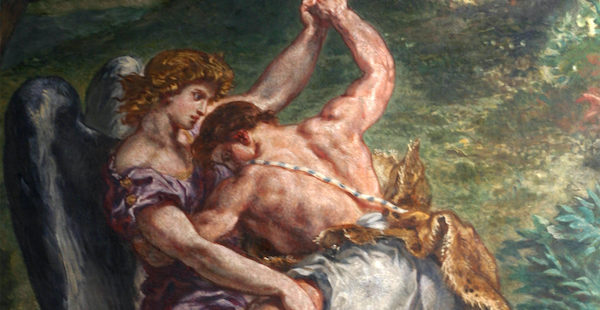
The defining moment of Jacob’s life comes at the Jabbok River, on the eve of his reunion with Esau (Gen. 32:22–32). There Jacob wrestles through the night with a mysterious man (God in some kind f human form?), refusing to let go without a blessing.
Here Jacob is finally stripped of his cleverness and strength. He is given a new name: Israel, meaning “he struggles with God.” He also receives a limp, a permanent reminder that blessing comes through dependence, not manipulation.
Changed, Yet Not Perfect
Jacob meets Esau with humility and reconciliation (Gen. 33), showing real growth. Later, at Bethel, God reaffirms his new identity and covenant promises (Gen. 35). Yet Jacob remains flawed, showing favouritism among his sons, which leads to further family pain (Gen. 37).
Even so, Scripture remembers Jacob not only as a struggler, but as a worshipper. At the end of his life, he leans on his staff and worships God (Gen. 47:31; Heb. 11:21). The man who had once grasped now rests, and trusts.
Jacob in the Bigger Story
Jacob stands as a picture of the Christian life, marked by struggle as well as blessing, by frequent failure, but also gradual transformation. God’s grace meets him repeatedly, reshaping him over time. His story teaches us that God does not wait for us to be perfect before he works through us.
Lessons for Life:
- God uses flawed and broken people.
Jacob’s story reminds us that God’s grace is greater than our failures. - Struggle can be a place of transformation.
Wrestling with God can lead to deeper faith and dependence. - Blessing comes through surrender, not control.
Jacob’s limp teaches us that weakness can become the doorway to grace. - Faith is often a long journey.
Transformation usually happens over years, not moments. - True maturity ends in worship.
Jacob finishes his life not striving, but leaning and worshipping.



Leave a comment