
Joshua – From Faithful Spy to Bold Leader
(Exodus–Joshua)
Joshua’s story is one of steady courage and quiet obedience. He is not a reluctant prophet like Moses, nor a flawed king like David. He is a servant seemingly formed in another man’s shadow, but with his own relationship with God and a distinctive call from God. He is shaped by wilderness years, and entrusted with the unfinished promise to lead God’s people into the land of Canaan. His life is marked by trust in God’s presence and commitment to God’s covenant. Like Moses, Joshua’s leadership points beyond itself – to Christians’ possession of their rich inheritance in Christ.
A Young Warrior in the Wilderness
Joshua first appears as a military commander, leading Israel against Amalek while Moses prays on the hill (Exod. 17:8–16). From the beginning, his strength is linked to dependence. Victory flows not merely from the sword in his hand, but from the staff raised in intercession.
He becomes Moses’ assistant, accompanying him partway up Sinai and lingering at the tent of meeting (Exod. 24:13; 33:11). Long before he leads publicly, he learns to remain near God’s presence. Spiritual leadership grows out of close proximity to the God who leads us.
A Different Spirit Among the Spies
When sent to explore Canaan, Joshua sees the same fortified cities and towering warriors as the other spies (Num. 13–14). But he interprets them differently. Where others see impossibility, Joshua sees promise.
He and Caleb urge the people not to rebel: “The LORD is with us.” His courage is not denial of danger, but an expression of confidence in God.
For this dream, Joshua must wait. Forty years pass in the wilderness because of the people’s unbelief. The faithful suffer alongside the fearful. Yet Joshua does not grow bitter. He remains steadfast.
Commissioned to Continue
As Moses’ life draws to a close, Joshua is publicly commissioned (Deut. 31). The call is clear and repeated: “Be strong and courageous.” The foundation is equally clear: “The LORD himself goes before you.”
Joshua does not just replace Moses. He continues what Moses began. He inherits both the promise and the unfinished work.
Crossing Over: From Wilderness to Promise
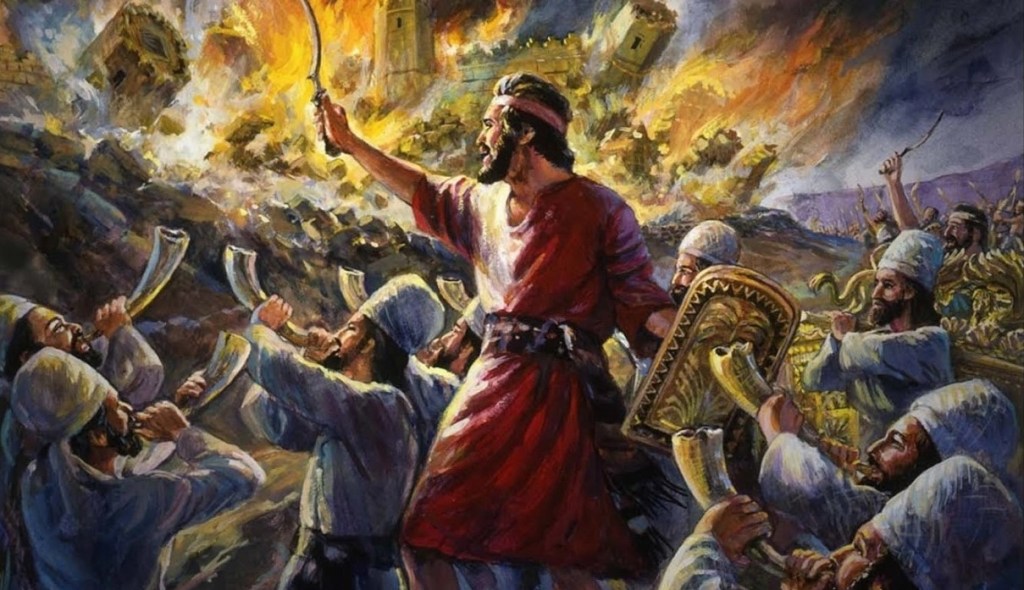
Under Joshua’s leadership, the Jordan parts and Israel steps into the land (Josh. 3–4). Memorial stones are raised so that future generations will remember. The conquest of Jericho follows, not through conventional strategy, but through obedient procession and patient trust (Josh. 6).
Again and again, Joshua learns that victory belongs to the LORD. Yet there are sobering moments. After early success, Israel is defeated at Ai because hidden sin remains in the camp (Josh. 7). Later, Joshua makes a treaty with the Gibeonites without seeking the LORD (Josh. 9). Faithful leadership still requires vigilance.
The land is largely subdued, but not entirely. The land is entered, though not fully possessed.
Covenant Renewal and Final Words
Near the end of his life, Joshua gathers the tribes at Shechem (Josh. 24). His concern is no longer conquering territory, but commitment and allegiance.
“Choose this day whom you will serve… as for me and my house, we will serve the LORD.”
The warrior’s final act is not a battle, but covenant renewal. He understands that the true struggle is always spiritual. The land matters, but loyalty to God matters more.
Lessons for Life:
- Faith sees differently.
The same situation can produce fear or faith. Your perspective will shape your response. Where others saw giants and impossibility, Joshua saw promise and the power of God to help them overcome. - Hidden years prepare visible calling.
Serving in another’s shadow need not be frustration but formation. The quiet obedience today becomes the significant leadership tomorrow. - Courage is sustained by God’s presence.
True spiritual strength is never self-generated. Joshua’s boldness flows not from his personality or temperament, but from God’s assurance, “I will be with you.” - Success requires continued dependence.
Even after Jericho, discernment was still needed. A period of success can dull our attentiveness. Yesterday’s victory does not remove today’s need to seek God. - The greatest leadership calls for decision.
Joshua does not only conquer the enemies and possess the land. He summons the people to commitment: “Choose this day whom you will serve.” Spiritual leadership ultimately calls us toward allegiance to God.



Leave a comment