
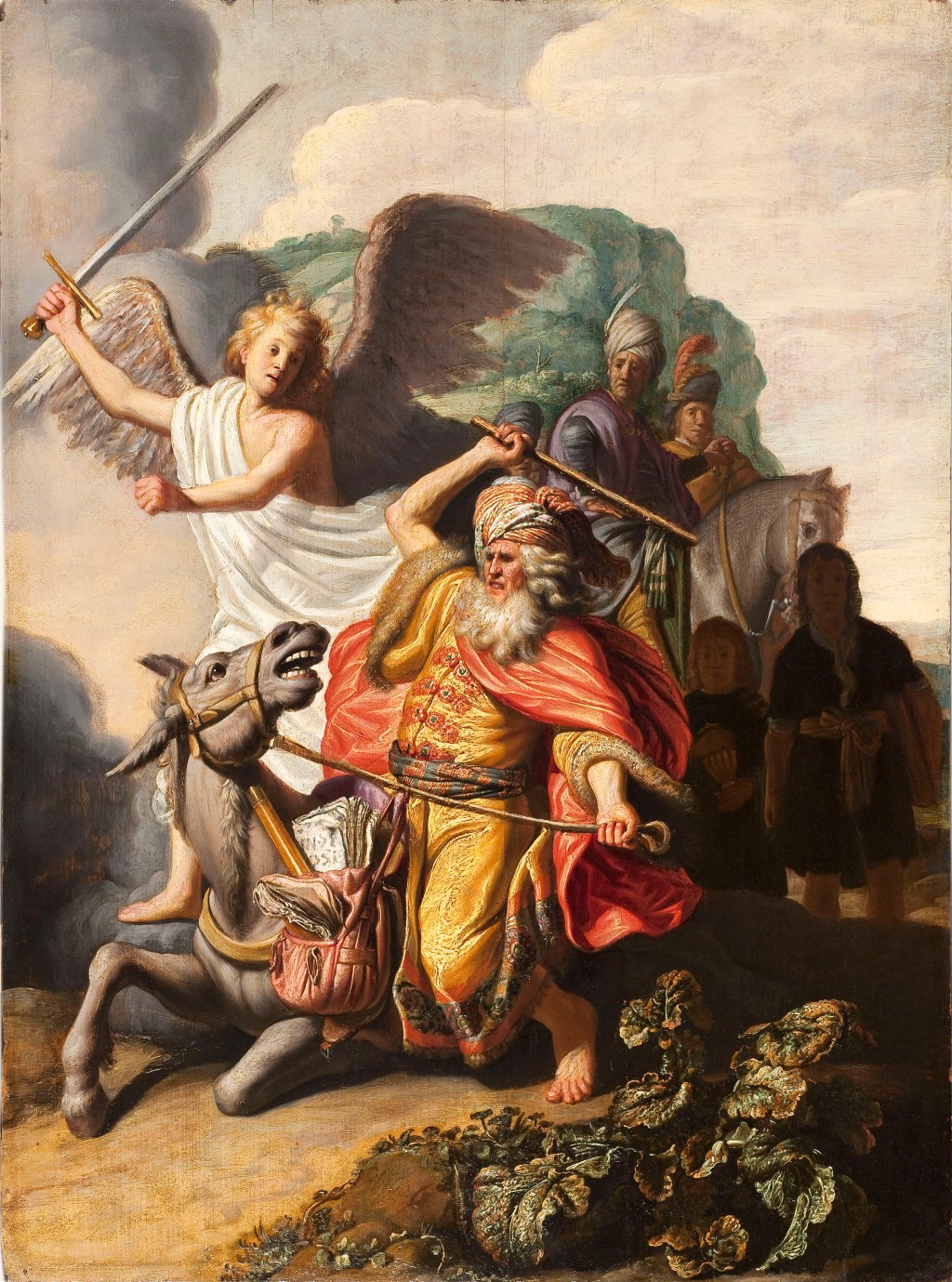
Balaam – The Prophet Who Could Not Curse
(Numbers 22–24; 31)
Balaam is one of the most mysterious figures in the Old Testament. He is neither Israelite and so is not a member of God’s covenant people, yet he speaks true words from the living God. He is a seer with spiritual insight, but also a man with a divided heart.
His story is one of constrained obedience and compromised desire. He cannot curse whom God has blessed. Yet he also reveals how easily spiritual gifting can coexist with moral instability. Balaam stands as a warning: it is possible to speak for God and still love the wrong things.
A Hired Prophet with a Divided Motive
Balak, king of Moab, summons Balaam to curse Israel as they camp near his borders (Num. 22). Balaam seeks God’s counsel and initially refuses. Yet when greater honour and reward are offered, he asks again.
God permits him to go but with boundaries: he may only speak what God gives him.
On the journey, Balaam’s donkey sees the angel of the LORD blocking the path while Balaam himself remains blind (Num. 22:22–35). The irony is sharp. The professional seer cannot see. The animal does. Balaam’s spiritual perception is already clouded by his greed.
Blessings Instead of Curses
Three times Balaam attempts to pronounce a curse over Israel (Num. 23–24). Three times, blessing pours out instead.
He declares that Israel is chosen, numerous, and protected:
“How can I curse those whom God has not cursed?”
His final oracle looks even further ahead:
“A star will come out of Jacob; a sceptre will rise out of Israel.”
Balaam becomes an unwilling herald of the promise of God. His lips speak truth his heart does not fully embrace. God’s sovereignty overrules human intention. No manipulation, no payment, no political pressure can overturn divine blessing.
Compromise Behind the Scenes
Yet the story darkens. Later Scripture reveals that Balaam advises Moab how to seduce Israel into idolatry and immorality (Num. 31:16; cf. Num. 25). Unable to curse Israel directly, he finds another way to weaken them – from within.
The prophet who could not curse becomes the counsellor who corrupts. Balaam is eventually killed when Israel defeats Midian (Num. 31:8).
The New Testament presents him as a warning against greed and spiritual compromise (2 Pet. 2:15; Jude 11; Rev. 2:14). Balaam becomes shorthand for loving “the wages of wickedness.”
Lessons for Life:
- Spiritual gifting does not guarantee spiritual integrity.
One may speak truth and still harbour compromise. - God’s purposes cannot be manipulated.
No power can reverse what God has blessed. - Divided motives dull spiritual sight.
Balaam’s blindness begins long before the angel blocks his path. - The greatest danger may be indirect compromise.
When open opposition fails, subtle seduction often follows. - The heart matters more than the words.
Faithfulness is not merely saying what is right, but loving what is right.
Balaam remains a sobering figure — a prophet who hears God’s voice, yet does not submit to it.
His story reminds us that proximity to revelation is not the same as obedience, and that the most dangerous compromise is often the one we justify while still speaking holy words.



Leave a comment