
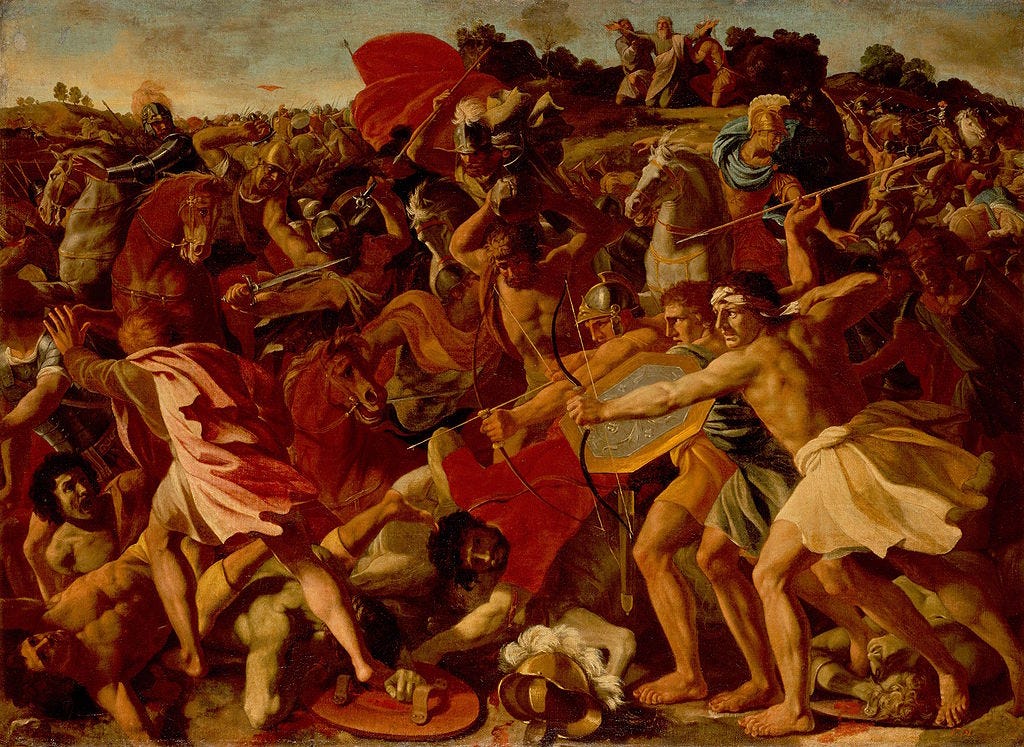
As people continue reading the Bible through the year with Bible Tour, many have reached the book of Joshua, and it has thrown up some difficult moral questions. Most notably, does God really command genocide?
I remember when I first began to teach theology, I shared with my mentor some of the questions and struggles I had with parts of the Bible. One of the main ones was exactly this one: how could the God of love and mercy revealed to us in Jesus Christ seemingly command the wholesale slaughter of people, including children. I respected this man and was surprised when he dismissed such questions, telling me simply to just ‘have faith.’ Perhaps we don’t need to fear such questions, but neither is it wrong to ask them. Honest wrestling with Scripture can deepen, rather than diminish, our faith (see Psalms 13; Habakkuk 1:2–4).
As I know some are currently wrestling with this question, I though it worth briefly exploring some of the main ways these passages have been understood. This is not exhaustive, but it may help frame the conversation.
Divine Judgement Catching Up With The Canaanites?
This is the traditional but hard answer. Some argue these events reflect God’s righteous judgment on extreme evil. They argue that the Canaanites were not innocent victims but participants in extreme practices, including violence, exploitation and child sacrifice. In this view, God’s command is not arbitrary but just. Some also argue that God, as the giver of life, has the authority to judge it. But they add that this conquest is seen as a unique, unrepeatable act, not a moral model for us to follow.
This still leaves us morally uneasy – did the children need to be massacred too? And how does this square with the mercy and forgiveness and enemy-love that Jesus taught and demonstrated? And if this was a unique act, have there not been other societies equally violent?
Not as Literal as It Sounds?
Other scholars note that ancient war accounts often used exaggerated language. Phrases like ‘destroyed all’ may be rhetorical. Indeed, groups that had supposedly been ‘wiped out’ reappear later (e.g., Judges 1). If so, this could be ‘hyperbolic war language’, actually saying ‘we decisively defeated them,’ not ‘we killed every last person.’
This may ease some of the tension. But it still leaves us with God apparently commanding violence, and we are left asking how this aligns with the way of Jesus (Matthew 5–7).
Human Distortions in Divinely Inspired Scripture?
Some simply acknowledge that these texts may reflect human misunderstanding. Peter Enns, for example, argues that the Bible is both divine and human, and that its human dimension includes cultural assumptions and limitations. The Israelites, like other ancient peoples, may have believed God commanded things that God did not actually command. They just got it wrong, in other words.
But this approach raises its own problems. Who decides which parts of the Bible are truly from God and which are mistaken? It risks leaving us with a fragmented and uncertain Bible, and we can end up creating our own idea of God in our own image!
Meeting Humanity Where It Is?
A more compelling approach is that of progressive revelation. God does not reveal everything all at once but works within human culture, gradually leading people toward the truth.
Ancient Israel understood God through a cultural lens shaped by warfare. These texts reflect a genuine encounter with God but are not the final word. They show how God was understood at the time, not the fullest expression of his character.
That fuller revelation comes in Jesus Christ, who teaches enemy-love (Matthew 5:44) and rejects violence, even to save himself (Matthew 26:52).
This approach takes Scripture seriously as inspired, while recognising a developing understanding across the biblical story.
Looking for the Deeper Meaning?
We are not the first to struggle with these passages. In the third century, Origen argued that the conquest narratives should not be read literally, but spiritually.
For Origen, the enemies represent sin and evil within the human heart. The command to ‘leave nothing alive’ becomes a call to radical transformation: do not tolerate destructive patterns in our lives but root them out completely (see Colossians 3:5).
Though often dismissed, this approach is now being reconsidered. It offers a meaningful way to apply these texts, even if it does not resolve every historical question.
A Way Forward
Each of these perspectives offers something valuable. But two, in particular, seem most helpful when held together: progressive revelation and spiritual interpretation.
Progressive revelation allows us to take the inspired text seriously without assuming that every detail reflects God’s ultimate will. It recognises movement, growth, and tension within Scripture.
An illustration I once heard was helpful if not perfect. Imagine a missionary doctor entering a tribal culture with deeply ingrained harmful practices, such as FGM. If he tries to abolish them immediately, he will be rejected. Instead, he embeds himself in the culture and patiently works to bring change from within, eventually leading them to a better way.
In a similar way, God meets humanity where it is, enters into its fallen culture, and leads it forward over time. This is why it is vital to remember that the Old Testament gives an important but partial picture. The full revelation of what God is like comes in Christ.
Long ago God spoke many times and in many ways to our ancestors through the prophets. And now in these final days, he has spoken to us through his Son…The Son radiates God’s own glory and expresses the very character of God,.. (Hebrews 1:1-3 NLT)
We no longer believe in the very things that God seemed to participate in exactly because he came in the person of Christ. He showed us what God is truly like and taught us a better way. He is the one who chose to die for his enemies rather than destroy them (Romans 5:8).
Because Jesus also taught us that the Old Testament was actually all about him (Luke 24:27), it is legitimate to interpret these passages spiritually. Although they are grounded in history, their deepest meaning now becomes clear. Because of the revelation of Christ we now know that:
‘we are not fighting against flesh-and-blood enemies, but against evil rulers and authorities of the unseen world, against mighty powers in this dark world, and against evil spirits in the heavenly places.’ (Ephesians 6:12)
This spiritual interpretation can be applied in two ways. Firstly to our own inner battle with sin and the idols of the heart, as we seek to enter into our inheritance in Christ (our promised land). We are encouraged to ‘put to death’ whatever would lead us into sin (Colossians 3:5; Matthew 5:29–30).
Secondly, I’d also suggest we can apply this in an outward way as we seek to advance the kingdom of God in our world, standing against evil. We don’t wage war against people or try to use the weapons of this world (2 Corinthians 10:3), but we might rightly talk about ‘ a war on poverty’ or ‘smashing the gangs’ involved in human trafficking, for example.
Read the Bible in the light of Christ
In the end, these are not easy texts. But they are not the final word. We read them in the light of Christ, who shows us the heart of God most clearly. And as we wrestle, we do so with trust: that the God we meet in Jesus is the same God who has been patiently at work all along in our world. And he is still working in our world now. And we are called to work with him, to see righteousness and justice, peace and compassion flourish in our world today.
Further Reading:
One Christian publisher helpfully produces a series of books (the Counterpoint series) on controversial Christian topics. There is an excellent one on this subject called Show Them No Mercy.
Andrew Ollerton of the Bible Society has recently brought out a Book on the Bible’s 7 Toughest Topics, and it includes something on this challenging subject.
I have written an earlier article about Wrestling with Scripture – you can read it here.




Leave a comment