
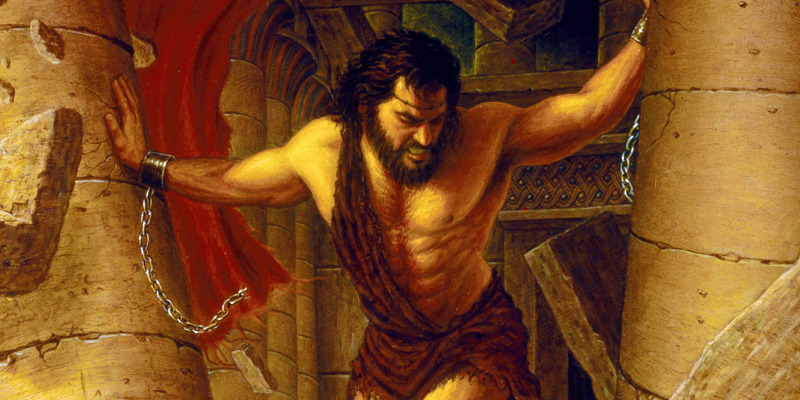
Samson – Strength Without Surrender
Samson is one of the most striking and tragic figures in the Old Testament. Set apart from birth as a Nazirite, he is called to begin delivering Israel from the Philistines. Endowed with extraordinary strength, he lives a life that is anything but disciplined or devoted.
His story is one of divine gifting mixed up with human weakness. Samson defeats enemies with supernatural power, yet repeatedly gives in to impulsive desires. He is a man empowered by God, yet is so often ruled by his appetites. Samson stands as a warning to us all: it is possible to be used by God and still remain deeply unformed within.
Set Apart for god
Before his birth, Samson is chosen by God and set apart as a Nazirite (Judges 13:5), called to live a life of consecration.
He is to avoid wine, unclean things, and never cut his hair, a visible sign that his strength comes from God.
Yet from early on, Samson shows little concern for this calling. His life begins with promise, but already carries the seeds of tension between his calling and his desire.
Power Without Restraint
Samson’s strength is undeniable. He tears apart a lion with his bare hands (Judges 14:6), defeats enemies in dramatic fashion, and strikes fear into the Philistines.
Yet his victories are often personal and impulsive, driven by anger, revenge, or desire rather than a clear sense of mission.
He burns fields, kills in retaliation, and lives reactively. God’s power is present, but it is not matched by God’s character. (This seems very relevant to the times we live in when too many Christians are supporting a leader who uses power in this way and totally lacks character or true devotion to God!)
A Divided Heart
Samson is driven by appetite, drawn repeatedly to Philistine women, ignoring both wisdom and calling.
His relationship with Delilah becomes the turning point (Judges 16). Pressed and worn down, he finally reveals the secret of his strength. When his hair is cut, his strength leaves him. The ensuing tragedy is quiet and devastating:
“He did not know that the Lord had left him” (Judges 16:20).
Strength Through Surrender
Blinded and imprisoned, Samson is brought low. The strong man becomes weak. The judge becomes a spectacle. Yet in his final moments, he turns back to God. In a last prayer, he asks for strength once more, not for pride this time, but for the purpose of defeating the enemy.
As he brings down the Philistine temple (Judges 16:28–30), his death achieves more than his life, in terms of overcoming the enemy. Strength is finally combined with some sense of surrender, even if desperate and destructive.
Lessons for Life:
- Gifting is not the same as godliness.
Great ability can coexist with deep immaturity. - Calling requires formation.
A set-apart life must be lived, not just received. - Unchecked desires lead to downfall.
What we repeatedly give ourselves to will form or deform us. - God’s presence should never be presumed.
Samson’s greatest tragedy is not his weakness, but his unawareness. - It is never too late to turn back.
Even in failure, surrender can restore purpose.
Samson remains a sobering and strangely hopeful figure. A man of immense strength and deep weakness. His life reminds us that God looks not only for power, but for surrender, and that true strength is found not in what we can do, but in how much we yield to God.



Leave a comment