
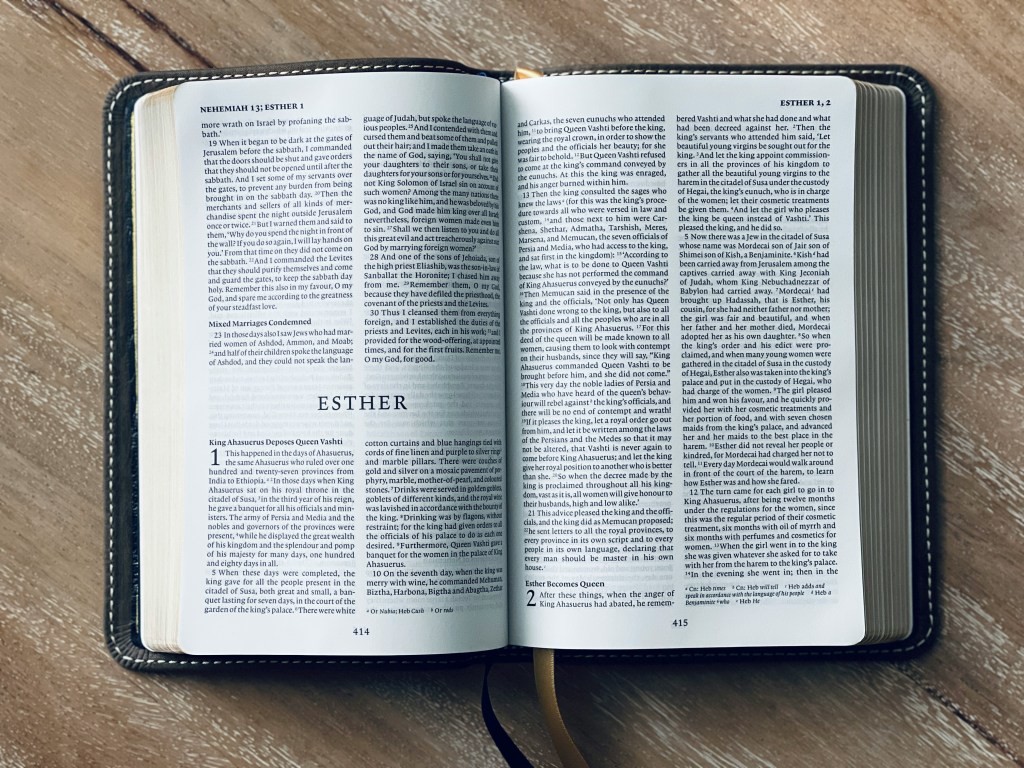
The events recorded in the book of Esther happened between the first return of the exiles, led by Zerubbabel, and the second return, led by Ezra. They give us an insight into life for the Jews remaining in Persia and how they were saved from genocide. A faithful Jewish man, Mordecai, and his cousin Esther, who he has brought up, are used by God to frustrate the evil plot of the King’s official, Haman, to destroy the Jews. It clearly shows that God is able to take the worst of human evil and turned it around to bring out good and to further his purpose.
Providence and Preservation
Although the name of God is not mentioned once in this book, God is clearly behind the events, working his purpose out. This is often referred to as providence. This refers to the invisible activity of God behind what is happening in our world as he sovereignly orders the normal processes of human affairs in order to carry out his intended purpose. It is not that we are like puppets on his strings nor that God is manipulative. But in his wisdom and grace, he uses the free choices of people and orchestrates them for good purpose.
Even in the hostile, volatile and capricious world of human politics and the violence of that ancient world, God sovereignly protects his own people through the work of Mordecai and Esther. We see here that, even when exiled in a foreign land and under threat from an evil and violent official, God preserves ‘the seed of Abraham’. By this we mean the line of people from whom the Christ is going to come. This is a repeated theme throughout the Bible – God protects his people and preserves his seed. Also, when God seems absent (he is not even mentioned in the book) he is actually present behind the scenes working his purpose out.
God’s People in God’s World
The book of Esther also shows how God wants to use his people in positions of influence in order to extend his purpose. The foreign powers of the Old Testament represent the kingdoms of this world. God raises up Esther to the kingdom for just the right time (4:14). Mordecai is also well-placed to be used by God. His faithfulness and wisdom cause him to be raised to a position of even greater influence in the kingdom.
God still wants his people not to retreat from the world but to be placed in positions of influence in the world. He does this in order to further the purpose of extending God’s Kingdom until the kingdoms of this world become the Kingdom of God and of his Christ (Revelation 11:15). Like Mordecai and Esther, however, they are to represent radically different values and the kingdoms of this world. than the political kingdoms of this world. Like them, we are to show qualities like honesty, integrity, humility and wisdom.
Authority and Honour
Another theme in this book is about how we respond to authority in society. We witness the abuse of authority – of Ahasuerus over Vashti, for instance, and of the king and Haman over the people. An attitude of submission and legitimate deference to authority is demonstrated by both Mordecai and Esther. But there is necessarily a limit to obedience. We see Esther have to go against the king’s edict to seek his favour and Mordecai refuses to bow down to Haman. It is good and right to be submitted to delegated authorities which are instituted by God (Romans 13:1) but our obedience to God is paramount and may sometimes require us to disobey men. We must obey God rather than men (Acts 5:29).
We should also note that Haman abused his authority because he wanted honour from men. Mordecai refuses to give it because the honour that Haman sought was due only to God. Ultimately the man who sought honour was forced to honour the simple, humble man. He was impaled on the very stake he had prepared for Mordecai. God truly does oppose the proud and gives grace to the humble (James 4:6).
See a great overview of the book here at Bible Project.
You can also hear Tim Keller showing how we can discover the gospel in the book of Esther here.



Leave a comment