
A fresh, grounded vision of living everyday life with the Holy Spirit.
I have at times been a reluctant charismatic. I have always wanted to be open to the Holy Spirit of course, knowing how vital he is for living the Christian life. Almost all of my Christian journey has taken place within charismatic churches. I love the passionate and expressive worship, and I have experienced something of the miraculous. But I am also painfully aware of how easily ego and emotionalism get pulled into the mix to sully the genuine work of the Spirit. I have seen leaders and others use supposed experiences or gifts of the Spirit as tools of manipulation and abuse. And, let’s face it, some elements of the movement have simply been strange and silly — charismania as it has been called.
A Distinctive Voice
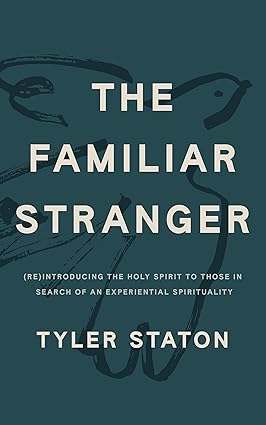
That is why it has been so refreshing and encouraging to read Tyler Staton’s latest book, The Familiar Stranger. His voice is distinctive. He writes as someone shaped in an evangelical but not charismatic context, yet with a deep hunger for a personal relationship with the Spirit, an experiential spirituality rather than an abstract belief. That position allows him to see both the wonder and the danger of God entrusting his power to flawed people like you and me. He therefore treads a wise path between the shallowness of emotionalism and the cynicism often behind the maintaining of an intellectual distance.
I did not especially like the way the book was structured, and in a couple of places Staton wanders into intellectual asides — such as his reflections on the Enlightenment — that felt heavier than necessary. But these are minor quibbles about what is otherwise a book of real substance, combining theological depth with practical insight.
The first section develops a strong biblical theology of the Holy Spirit as the presence of God with us, drawing especially on the temple motif, while also exploring other biblical images. Again and again, Staton asks what these mysterious biblical pictures mean for our lived experience today?
Missing the Spirit
A good example of his balanced approach comes in the book’s second section (Spiritual Experience as Everything or Nothing). Here Staton considers two contrasting ways we can miss the Spirit. Simon the Sorcerer represents the danger of ego-driven misuse of power. Nicodemus represents the danger of intellectual curiosity without encounter or experience. As a long-time charismatic, I was surprised to find it was Nicodemus who unsettled me most. It is all too easy to let life in the Spirit remain in the realm of theory and theology, rather than to live with him in everyday experience. Staton doesn’t allow us that option.
Gifts in Practice
The book is strongest when it turns to practice. The chapters on the spiritual gifts are full of insight, grounded in his own experience, and offered with pastoral care. His treatment of discernment is outstanding, showing how listening for God’s voice is less about dramatic and extraordinary moments and more about hearing his still, small voice in the ordinary. He also wisely but clearly considers the work of the enemy, with helpful counsel on distinguishing the wheat and the weeds in the soil of our own souls.
His chapter on prophecy is equally refreshing for someone who grew up where prophecy often came in weighty “Thus says the Lord” pronouncements. Here he is honest and humble as he speaks of learning to hear and share the words of God with others. He encourages the use of imagination as a primary way God begins to speak to us, though I can understand that some readers might wish he had said more about discernment in relation to our subjective impressions. But his practical advice is excellent, such as if you want to learn to prophesy start by exercising the gift of encouragement.
Another favourite chapter for me was the one on witness, not usually included in a list of spiritual gifts though Jesus said it was the main purpose for which the Holy Spirit was given. Staton reminds us that evangelism is not a sales pitch or ‘working product placement into a genuine friendship.’ It is a life lived in honesty and transparency before others. The challenge is not to “get the gospel in” to our conversations but to speak openly about how the gospel is shaping us. This is shifting the challenge to where it should be. Yes, let’s be bolder and unapologetic about sharing what and who is most important to us but as the loving overflow of a life lived honestly before God and others, not as an evangelistic strategy.
Suffering and Love
Perhaps the most moving chapter comes as Staton writes from a hospital room, receiving chemotherapy for cancer. His reflections on redemptive suffering are not theory therefore but a very present lived reality. He writes of a Spirit who is not only present in victory but who is with us in the valleys. Possibly we experience him most deeply and fully there.
The final chapters circle back to the way of love. For Staton, love is not just the context in which the Spirit’s gifts are exercised but part of the miracle itself. Love is the Spirit’s greatest work, as he forms in us the ability to love others and stick with others, to stay rooted, learning to love well in the earthy reality of community.
For all my minor reservations about structure, I am grateful for the theological depth Staton lays down and the pastoral wisdom he shares. The Familiar Stranger is a book that refuses to reduce the Spirit to a theological concept or devotional cliché. He invites us to risk an authentic, lived friendship with the Spirit who is the very presence of Jesus himself with us. I invite you to read it and live it.
Taster Quotes
The tabernacle and temple represent an era of presence without intimacy—good, but incomplete.
When the leader’s ego is driving the pursuit of supernatural ministry, it distorts the Spirit’s power from a creative force producing freedom to a controlling force producing captivity.
I think Nicodemus, like many of us, wanted all his questions answered apart from the vulnerability of experience. If we want to know this King and live in his Kingdom, it can’t happen from a safe distance. It can’t happen by spectating. And it can’t happen without risk and surrender.
We tend to miss God in our midst, not because he’s too extraordinary but because he’s too ordinary. We tend to look for God in the wind, earthquake, and fire rather than the whisper.
That is what learning the Shepherd’s voice is like—by risk and obedience. There is no formula for this, only familiarity. We learn God’s voice by risk, so we must be willing to get it wrong if we’re ever going to get it right.
No one likes to be “evangelized to,” whether it’s about a timeshare in Tahiti, an essential oils pyramid scheme, or Jesus of Nazareth.
Speaking love isn’t about finding the city’s most crowded street corner with a bullhorn, and it’s not about turning your every conversation into a trap where you’re luring someone into the topic of the soul’s eternal destiny. Speaking love is just about completely honest living. It’s being your whole self equally in the disparate environments of your life—joys, struggles, practices, failures, and the sure place you rest your hope.
And the greatest miracle of all just might be living in a community of love over the long haul.
Find this book on:





Leave a comment