
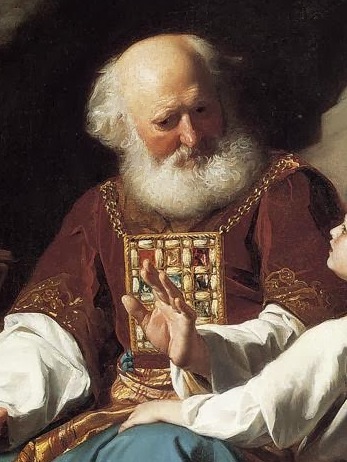
Eli – The Priest Who Failed To Act
Eli is a quiet and weighty presence at the beginning of 1 Samuel. As priest and leader in Israel, he occupies a place of spiritual responsibility at a time when the nation is drifting. He is not portrayed as openly rebellious, but as passive where he should be firm.
His story is one of gentleness without resolve. He honours God with his role, yet fails to confront what dishonours him in his own house. Eli stands as a warning: it is not only active disobedience that leads to ruin, but also the failure to act when action is required.
A Leader in a Fading Time
Eli serves as priest at Shiloh, overseeing the worship of Israel (1 Samuel 1:3).
Yet this is a time when ‘the word of the Lord was rare’ (1 Samuel 3:1).
He continues with the rituals of faith, but something deeper is missing. Eli represents a leadership that is still present, but no longer fully alert or discerning.
A Gentle but Passive Father
Eli’s sons, Hophni and Phinehas, abuse their priestly role, acting with greed and contempt for God (1 Samuel 2:12–17).
Eli rebukes them, but does not restrain them (1 Samuel 3:13). His words are right, but they lack weight. There is correction, but no decisive action.
The failure is not ignorance, but a reluctance to appropriately confront.
Recognising God’s Voice For Another
When the young Samuel hears God’s call, it is Eli who helps him understand what is happening (1 Samuel 3:8–9).
There is humility here. Eli recognises that God is speaking, even if not to him. Yet the message Samuel receives is one of judgment against Eli’s own house.
Eli’s response is striking:
‘He is the Lord; let him do what is good in his eyes‘ (1 Samuel 3:18).
There is submission, but also a sense of sad resignation. He knows it is deserved.
A Heavy Ending
In battle against the Philistines, Eli’s sons are killed and the ark of God is captured (1 Samuel 4).
When Eli hears the news, he falls backward and dies. The shock that leads to his death is not so much at the death of his sons but at the capture of the ark of God.
His life ends much as it was lived, marked by a deep concern for the presence of God and a clear sense of its worth, yet unable to lead in a way that could keep hold of it.
Lessons for Life:
- Passive leadership carries real consequences.
Failing to act can be as damaging as acting wrongly. - Spiritual responsibility begins at home.
Eli’s greatest failure is not public, but personal – in his family - Right words need decisive follow-through.
Correction without action does not bring change. - God may move beyond unresponsive leadership.
Samuel rises as Eli fades, a new voice for a new moment. - Resignation is not the same as obedience.
Accepting God’s judgment is not the same as preventing it through faithful action.
Eli remains a deeply human figure, a man who honours God in many ways, yet fails at a crucial point. His story reminds us that faithfulness requires not only knowing what is right, but acting on it with courage, especially when it is costly.





Leave a Reply