
Elijah – The Prophet of Fire and Whisper
Elijah bursts into Israel’s story suddenly and dramatically, challenging kings, confronting false gods, and calling a drifting nation back to God. In a time when Baal worship spreads through Israel under Ahab and Jezebel, Elijah stands almost alone. He is a prophet marked by courage, intensity, and fierce loyalty to God.
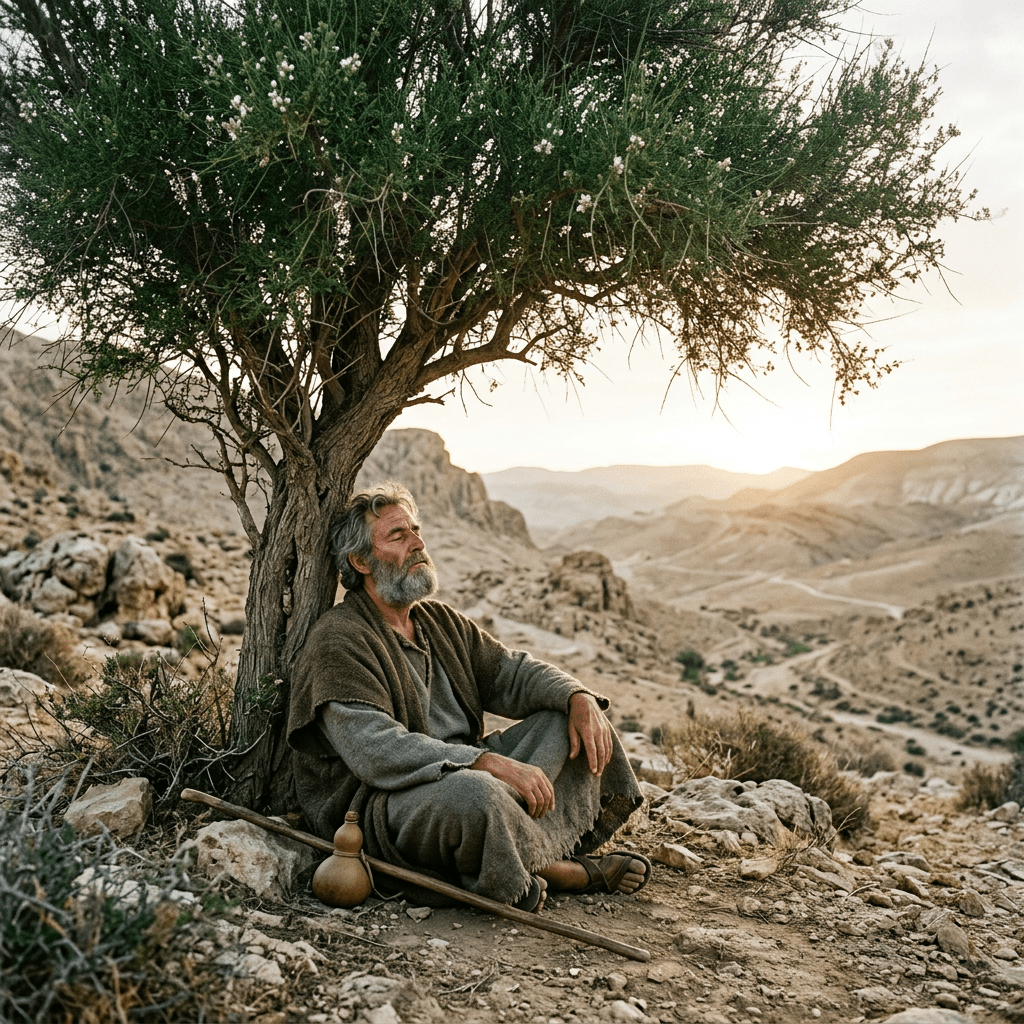
Yet Elijah’s story is not only one of fire from heaven and public victory. It is also a story of exhaustion, fear, and a quiet encounter with God. The bold prophet who stands before kings eventually collapses beneath a broom tree, discovering that God is present not only in power, but also in the finest whisper when at our most exhausted. Elijah reminds us that faithfulness can look fiery but also feel very fragile at times.
A Voice Against Idolatry
Elijah first appears announcing drought upon the land (1 Kings 17:1), confronting a nation that has turned to Baal, the supposed storm god.
His life becomes a direct challenge to false worship.
Whether confronting Ahab, providing for a widow, or raising her son, Elijah’s ministry reveals that the Lord, not Baal, is the true giver of life.
Fire on Mount Carmel
The defining moment comes on Mount Carmel (1 Kings 18).
Facing hundreds of prophets of Baal, Elijah calls Israel to decision:
‘How long will you waver between two opinions?‘
The prophets of Baal cry out with no answer. Elijah prays simply, and fire falls from heaven.
The scene is dramatic and decisive. God reveals himself not through frenzy or performance, but through his own sovereign power.
The Prophet Who Collapsed
Yet immediately after victory comes collapse.
Threatened by Jezebel, Elijah flees into the wilderness and prays to die (1 Kings 19:4).
The fearless prophet suddenly appears deeply tired and afraid.
His despair reveals something profoundly human. Even great faith does not make up for emotional exhaustion.
God in the Whisper
On Mount Horeb, Elijah encounters wind, earthquake, and fire, but the Lord is not in them (1 Kings 19:11–12).
Then comes ‘a gentle whisper’.
The prophet of fire must learn that God is not only revealed in dramatic acts, but also in quiet presence.
Elijah discovers that divine strength often meets us not in noise, but in stillness.
Passing the Mantle
Toward the end of his life, Elijah calls Elisha to follow him (1 Kings 19:19).
He prepares for the continuation of the prophetic ministry.
Finally, Elijah is taken into heaven in a whirlwind (2 Kings 2), leaving behind both a prophetic legacy and the hope that God continues his work through others.
Lessons for Life:
- Faithfulness may require standing alone.
Elijah confronts a culture that has drifted far from God. - God’s power is greater than false substitutes.
Idols promise life, but cannot answer or save. - Spiritual victory does not remove human weakness.
Even the strongest servants of God can become weary. - God speaks in quietness as well as power.
The whisper matters as much as the fire. - God’s work continues beyond one person.
Elijah passes the mantle on, trusting God with the future.
Elijah remains one of Scripture’s most compelling figures. He is a prophet of courage and intensity, yet also of vulnerability and need. His story reminds us that God meets us both on the mountain of triumph and beneath the tree of exhaustion, and that his presence is found not only in dramatic moments, but also in the quiet whisper that calls us onward.





Leave a Reply