
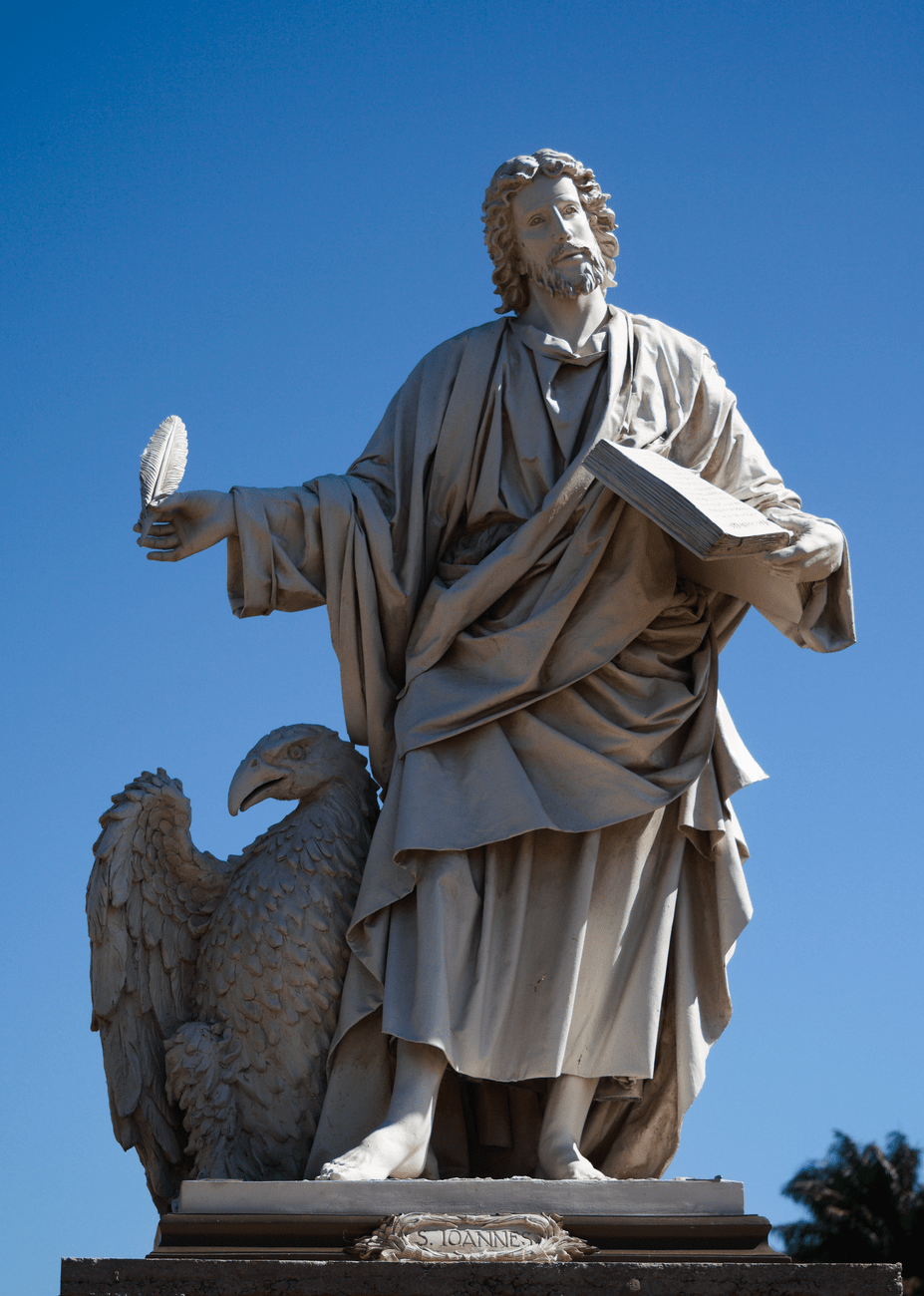
John – The Disciple Whom Jesus Loved
(The Gospels; Acts; 1–3 John; Revelation)
John is one of the most intriguing and influential figures in the New Testament. A fisherman from Galilee, he becomes one of Jesus’ closest disciples and later a key leader in the early church. Through his Gospel, letters, and the book of Revelation, John helps shape the Church’s understanding of Jesus more profoundly than almost anyone else.
Yet John’s story is one of transformation. He begins as an ambitious and fiery young man, eager for status and quick to judge. Over time, he becomes known as the apostle of love. John reminds us that proximity to Jesus reshapes the heart.
From Son of Thunder to Disciple
Jesus gives John and his brother James the nickname ‘Boanerges,’ meaning ‘Sons of Thunder’ (Mark 3:17).
The name fits. At one point, they want to call fire down from heaven on a Samaritan village that rejects Jesus (Luke 9:54).
On another occasion, they ask for the places of honour at Jesus’ right and left hand in his kingdom (Mark 10:35–37).
John begins as a man of passion and zeal, but also of ambition and impatience.
Close to Jesus
Along with Peter and James, John belongs to Jesus’ closest disciples, the three who were invited into some of the most significant moments in Jesus’s ministry.
He witnesses the raising of Jairus’s daughter, the Transfiguration, and Jesus’ agony in Gethsemane.
At the Last Supper, John is reclining beside Jesus and is referred to as the disciple who Jesus loved (John 13:23).
His closeness to Christ is not presented as a badge of superiority, but as a relationship that gradually shapes him.
The disciple who once sought greatness learns the greater privilege of simply being near Jesus.
Faithful at the Cross
When the other disciples flee, John remains near the cross (John 19:26–27).
There, Jesus entrusts his mother Mary to John’s care.
It is a small but significant moment. In the midst of suffering, Jesus finds in John someone who can be trusted with responsibility.
Love and service have replace ambition.
A Witness to Resurrection
John is among the first disciples to reach the empty tomb (John 20:3–8).
The Gospel records a simple but profound response:
‘He saw and believed.’
Throughout his writings, John repeatedly returns to the themes of light, life, truth, and belief.
He writes not as a detached theologian, but as a witness who has seen and experienced the reality of Christ for himself.
The Apostle of Love
In his later years, John’s writings are saturated with one theme above all others – love.
Again and again he speaks of God’s love, Christ’s love, and the call for believers to love one another.
His most famous words capture the heart of his message:
‘God is love’ (1 John 4:8).
The son of thunder becomes the apostle of love. His greatest transformation is not in what he knows, or what he does, but in who he becomes.
Lessons for Life:
- Jesus transforms character over time.
John’s journey shows that spiritual maturity is a process. - Closeness to Jesus changes us.
Relationship with Christ shapes the heart as well as the mind. - Faithfulness matters in difficult moments.
John remains near the cross when many others leave. - Truth and love belong together.
John’s writings hold both firmly, refusing to sacrifice one for the other. - The greatest mark of maturity is love.
A life shaped by Christ increasingly reflects his heart.
John remains one of Scripture’s most compelling examples of transformation. The fiery young fisherman becomes a wise shepherd, theologian, and witness. His story reminds us that following Jesus is not merely about gaining knowledge, but about becoming the kind of person who reflects God’s love to the world.





Leave a Reply